
Toilet Chemicals and Campsites: Are You Being Given the Full Picture?
Every year, thousands of litres of caravan and motorhome toilet waste are emptied at campsites across the UK. But how much do campsite operators really know about the chemicals being discharged into their wastewater systems, or what happens when these products are accidentally spilled onto their land?
For campsite owners, this is not simply an environmental question. It is about protecting their land, maintaining expensive sewage treatment systems, safeguarding staff and visitors, and understanding the potential financial and legal consequences of pollution.
Not all toilet fluids work in the same way
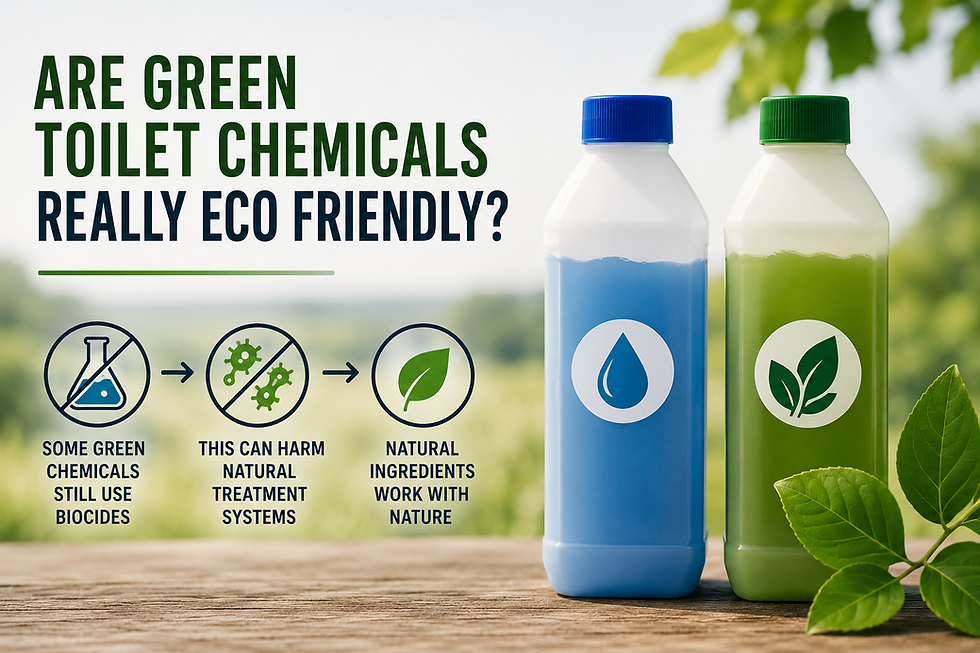
Caravan and motorhome toilet fluids have traditionally been divided into two categories: blue and green. Blue products are generally associated with powerful chemical treatments, while green products are marketed as more environmentally friendly alternatives, often described as suitable for septic tanks.
Unfortunately, the colour of a product tells us very little about what it actually contains.
Some traditional toilet chemicals have used formaldehyde, a powerful disinfectant that suppresses the bacteria responsible for decomposition and odours. Many modern blue and green products instead use other antimicrobial substances, including bronopol, which also inhibits microorganisms.
Other approaches include enzyme-based products, which use enzymes to help break down organic material, and biological formulations that introduce bacteria to help process waste. There are also plant-derived products, such as Solbio, which are designed to support the natural decomposition process without relying on conventional biocides or adding bacteria and enzymes.
These differences matter, particularly when the waste is destined for a septic tank or biological sewage treatment plant.
Formaldehyde: a particularly concerning ingredient
Formaldehyde was historically used in chemical toilet fluids because of its effectiveness at controlling bacteria and preventing unpleasant smells. However, its hazardous properties are now well established.
The UK Health Security Agency identifies formaldehyde as a human carcinogen. It can also cause respiratory irritation, allergic skin reactions and, at sufficiently high concentrations, serious damage to the skin and eyes.
The International Agency for Research on Cancer classifies formaldehyde as carcinogenic to humans, based on evidence including occupational exposure and certain cancers. This does not mean that occasional contact with a properly diluted toilet fluid carries the same risk as prolonged industrial exposure. Nevertheless, it demonstrates why formaldehyde should not be regarded as an innocuous ingredient.
Formaldehyde presents environmental concerns too. Its antimicrobial properties can interfere with biological processes, and concentrated releases can be harmful to living organisms. Although formaldehyde can biodegrade, that does not make uncontrolled disposal environmentally acceptable.
Its use in toilet fluids has declined considerably, and many modern products are explicitly labelled formaldehyde-free. However, campsite operators should not assume that all traditional toilet treatments are free from it.
There is also an important distinction: a product being formaldehyde-free does not necessarily mean that it is free from other biocides or suitable for every septic tank.
Bronopol: the ingredient that deserves greater scrutiny
One chemical that has replaced formaldehyde in some toilet fluid formulations is bronopol, also known as 2-bromo-2-nitropropane-1,3-diol.
Bronopol is an antimicrobial substance used to control bacteria. It is found in some blue and green caravan toilet fluids, including products marketed as environmentally friendly.
This creates a question for campsite operators whose wastewater systems depend on bacteria to function.
Septic tanks and biological sewage treatment plants rely on microorganisms to break down organic waste. Introducing substances designed to inhibit microorganisms could potentially interfere with this process, depending on concentration, frequency of discharge, dilution and the characteristics of the treatment system.
A busy campsite might receive dozens of toilet cassette discharges over a weekend. The effect of repeated exposure is therefore an important consideration, particularly for smaller treatment systems.
Bronopol is also classified as very toxic to aquatic life in its concentrated substance form. Its environmental behaviour, including degradation and dilution, must be considered when assessing the risks associated with a particular product.
Importantly, the European Chemicals Agency's Biocidal Products Committee assessed bronopol for chemical toilet disinfection in December 2023. The committee did not recommend approval for that use because the available information was insufficient to establish that the relevant risks were acceptable.
This does not mean every product containing bronopol has been proven environmentally damaging, nor does an EU assessment automatically prohibit its sale in Great Britain. It does, however, raise reasonable questions about the evidence supporting claims of environmental friendliness and septic-tank compatibility.
Are green toilet fluids really safe for septic tanks?
Some manufacturers claim that their green toilet fluids are suitable for septic tanks and support these claims with biodegradability testing.
Such evidence is relevant, but it is important to understand what the tests actually demonstrate.
For example, ISO 11734 is used to assess anaerobic biodegradability. It can provide useful information about how substances break down under particular test conditions.
However, biodegradability and compatibility with a functioning septic tank are not necessarily the same thing.
A substance might ultimately biodegrade while still affecting microorganisms during the period before it breaks down. Equally, a laboratory test may not reproduce the conditions found at a campsite where multiple toilet cassettes are emptied into a relatively small treatment system over a short period.
There is also an important difference between testing the biodegradability of a particular ingredient and demonstrating that the complete formulated product does not interfere with wastewater treatment.
These are reasonable questions that manufacturers should be able to address with evidence.
Campsite operators should be able to establish whether a product's septic-tank compatibility claims are supported by independent testing, what was actually tested, and whether the conditions reflect real-world campsite use.
Are there better alternatives?
Not all toilet treatments work by suppressing bacteria.
Enzyme-based products use biological catalysts to help break down organic material. Some biological treatments also introduce selected bacteria intended to assist waste decomposition. These approaches offer a potentially useful alternative to conventional antimicrobial toilet fluids because they do not necessarily depend on killing the microorganisms involved in breaking down waste.
However, their environmental performance and effectiveness depend on their complete formulation, the conditions in which they are used and the evidence supporting their claims. The presence of enzymes or bacteria alone does not guarantee septic-tank compatibility.
Another approach is to support the microorganisms already naturally present in waste.
Solbio, for example, uses plant-derived ingredients designed to encourage natural waste breakdown and control odours without conventional antimicrobial active ingredients. Rather than introducing additional bacteria or enzymes, its approach relies on the existing biological processes involved in decomposition.
For campsite operators, the important distinction is between a treatment that suppresses microbial activity and one designed to work alongside it.
This does not mean that any particular alternative should automatically be regarded as harmless or universally suitable. Products should be assessed on their actual ingredients, performance, environmental characteristics and available supporting evidence.
What matters is that campsite owners have enough information to make informed decisions about which toilet treatments they are prepared to accept.
What happens when chemicals are spilled on a campsite?
Most discussion about toilet fluids concentrates on what happens when waste enters an Elsan point. But chemicals can also be accidentally released elsewhere.
A visitor might drop a bottle of concentrated toilet fluid onto a grass pitch, spill the contents of a cassette while carrying it to the disposal point, or empty waste in an unsuitable location.
These incidents are particularly relevant because concentrated products may present different risks from correctly diluted waste entering a designated disposal system.
If chemicals enter the soil, run into surface-water drains or reach a nearby stream, pond or wetland, they could potentially harm the environment.
Bronopol's aquatic toxicity makes uncontrolled releases a particular concern. Formaldehyde also has properties that warrant careful handling, especially in concentrated formulations.
A product labelled green should not automatically be assumed safe to spill on grass, soil or near water.
The risk depends on the precise formulation, quantity released, local conditions and whether the chemicals can reach sensitive habitats or watercourses.
What if the campsite is in a protected area?
Many UK campsites are located in environmentally sensitive surroundings, including National Parks, National Landscapes, nature reserves and Sites of Special Scientific Interest (SSSIs).
These locations can present additional challenges.
An SSSI receives specific legal protection because of its important habitats, species or geological features. Chemical contamination that damages protected features may trigger conservation legislation or other environmental enforcement mechanisms.
Similarly, an uncontrolled chemical release that pollutes a stream, river or groundwater could attract the attention of the Environment Agency
The consequences depend on the severity of the incident, the substances involved, whether actual damage or a relevant offence occurred, and who was responsible.
Not every small spill amounts to a prosecutable offence. However, operators managing particularly sensitive locations have good reason to take precautions and understand the products being brought onto their land.
What does the Health and Safety Executive expect when a spill occurs?
An often overlooked issue is the procedure that campsite employees should follow when cleaning up toilet chemicals.
Under the Control of Substances Hazardous to Health (COSHH) Regulations, employers must assess relevant risks arising from hazardous substances at work and put appropriate controls in place.
Where employees may be required to clean up toilet chemical spillages, the campsite operator should consider those risks as part of its health and safety arrangements.
The manufacturer's Safety Data Sheet provides important information. Section 6 identifies the recommended response to accidental releases, while Section 8 describes appropriate exposure controls and personal protective equipment. Of course, you are unlikely to have the specific Safety Data Sheet to hand when delaing with a spill.
Depending on the product, the recommended precautions may include keeping people away from the spill, wearing protective gloves and eye protection, preventing liquid from reaching drains or watercourses, and using suitable absorbent materials to collect the contamination.
This is significantly different from simply washing the chemicals into the nearest drain or allowing them to soak into the ground.
There is no single HSE spill-cleanup procedure that applies to every blue or green toilet fluid. The correct precautions depend on the specific product and circumstances.
For campsite owners, this raises a practical question. If a visitor spills a bottle of toilet fluid on a pitch tomorrow, would staff know how to respond safely?
Having suitable spill-response materials, access to relevant product safety information and clear staff instructions could help prevent a relatively minor accident becoming a more serious problem.
Could the Environment Agency prosecute a campsite owner?
In England, the Environment Agency has powers to investigate pollution incidents and take enforcement action where relevant environmental legislation has been breached.
This could include incidents involving chemicals that enter controlled waters or situations where wastewater treatment systems discharge pollution.
Local authorities and Natural England may also have responsibilities depending on the location, type of incident and legislation involved.
Crucially, responsibility is not determined simply by who originally purchased or brought a chemical onto the campsite.
If a visitor accidentally spills a toilet fluid, the visitor may have caused the incident. However, the response of the campsite operator, the precautions already in place and the operator's responsibilities for the affected land or wastewater system could become relevant.
A campsite owner who has taken reasonable precautions and responds promptly to an accident is not in the same position as someone who knowingly permits harmful discharges.
The question is therefore not whether every spillage will result in prosecution. It is whether operators sufficiently understand the potential risks, and whether they have appropriate arrangements to manage them.
Who is responsible if a septic tank stops working?
For campsites with their own septic tanks or sewage treatment plants, the financial consequences of a problem can be significant.
Biological treatment systems can be expensive to maintain, repair or replace. Disruption may also affect a campsite's ability to operate.
In an April 2026 parliamentary response, the Department for Environment, Food and Rural Affairs confirmed that where toilet additives compromise the treatment provided by a campsite's septic tank, resulting pollution could lead to Environment Agency enforcement action against the operator.
This is an important consideration.
The manufacturer supplies the toilet fluid, the caravan owner chooses which product to use, but the campsite operator may ultimately be responsible for managing the wastewater and complying with the conditions governing its discharge.
Campsite owners already face substantial costs associated with wastewater management. They should not be expected to make decisions about the chemicals entering their systems without clear and reliable information.
There is a strong argument for manufacturers providing more transparent evidence, industry organisations offering consistent guidance and operators being able to choose which treatments are appropriate for their facilities.
A better approach for campsite owners
The camping industry has made significant progress in reducing its environmental impact, and toilet waste treatment should be part of that discussion.
There is no reason why campsite operators should have to rely solely on whether a toilet fluid is labelled blue, green, eco or biodegradable when making decisions about their wastewater systems.
Understanding the ingredients, the way they work, the evidence supporting septic-tank compatibility and the precautions required in the event of a spill is far more useful.
Formaldehyde's hazardous properties are well established. Bronopol raises different but legitimate questions about microbial inhibition, aquatic toxicity and the evidence supporting its use in environmentally marketed products.
Enzyme-based, biological and plant-derived alternatives offer other approaches to managing toilet waste, although their claims should also be supported by appropriate evidence.
Ultimately, campsite operators deserve confidence that the products being emptied onto their sites will not create unnecessary risks to their land, wastewater systems, staff, visitors or the environment.
Choosing products supported by transparent evidence, and favouring approaches that work with natural biological processes rather than suppressing them, is a sensible place to start.



Comments